
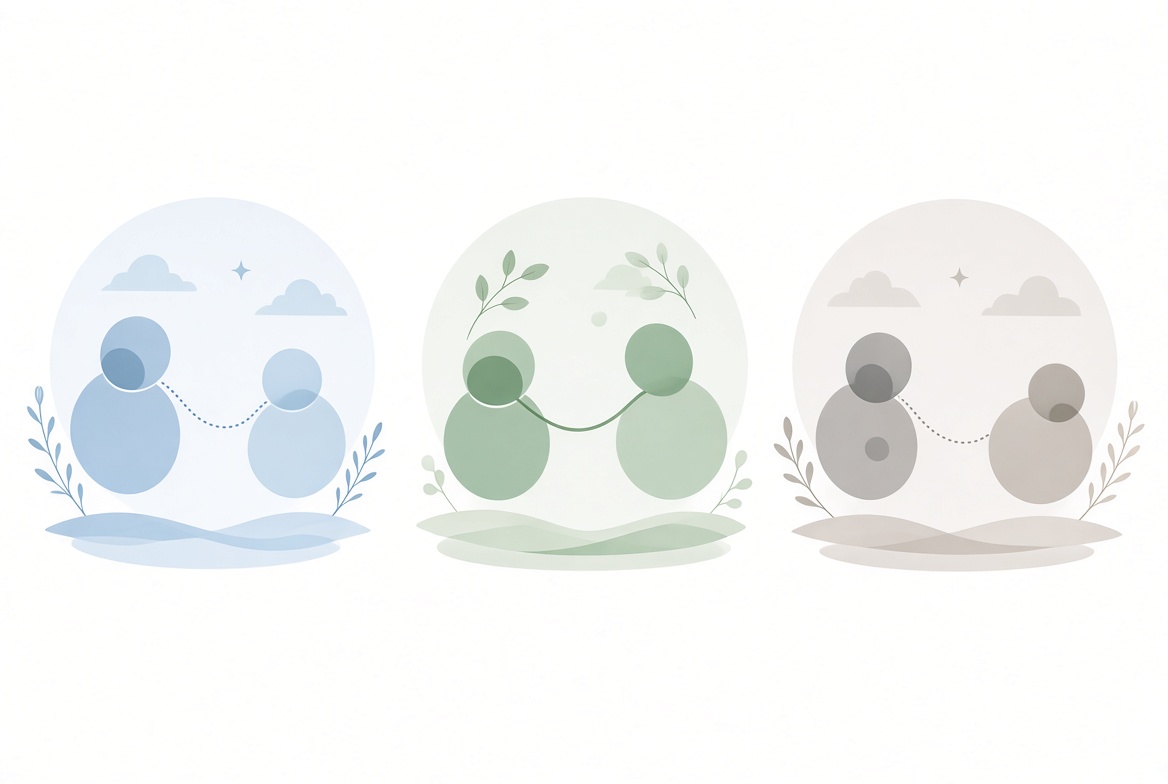
Attachment styles describe typical ways of seeking closeness and handling distance in important relationships. They are patterns, not permanent labels. Most people lean toward one style while showing traces of others depending on the partner and the stress level.
Here is a practical comparison of the three styles people ask about most often.
Secure attachment
Securely attached people generally expect that others can be available and that they themselves are worthy of care. They can move toward a partner when something is wrong and also tolerate ordinary space without panic.
In conflict they are more likely to stay engaged, state needs directly, and look for repair. Independence and intimacy both feel allowable.
Anxious attachment
Anxious attachment is organized around fear of abandonment or being “too much.” Closeness is desired intensely. Uncertainty — delayed replies, subtle shifts in tone — can trigger protest behavior: more messaging, more questioning, more emotional intensity.
The underlying need is usually reassurance and reliable connection. When that need is met consistently, anxiety often settles. When it is met unpredictably, the cycle intensifies.
Avoidant attachment
Avoidant attachment is organized around discomfort with too much closeness or dependency. Self-reliance feels safer. When emotions rise, the impulse is to minimize, intellectualize, or create distance.
Avoidant people often still care deeply. The strategy is protection: if I need less, I can be hurt less. Partners may experience this as coldness even when the avoidant person believes they are being reasonable.
See which pattern is strongest for you right now.
Take the Free Attachment Style TestHow they collide
The classic difficult pairing is anxious–avoidant. One partner pursues; the other withdraws. Each behavior confirms the other’s fear. Secure partners tend to interrupt this loop more easily because they can offer steady presence without either chasing or disappearing.
Two anxious partners may create high drama and high intimacy. Two avoidant partners may create a polite, low-conflict relationship that slowly starves of emotional depth.
Can your style change?
Yes. Experiences with consistently reliable people, clearer communication skills, and sometimes therapy can move someone toward greater security. A single test result is a snapshot of current tendencies, not a life sentence.
For a broader view of how you connect, also consider love languages and communication style.