
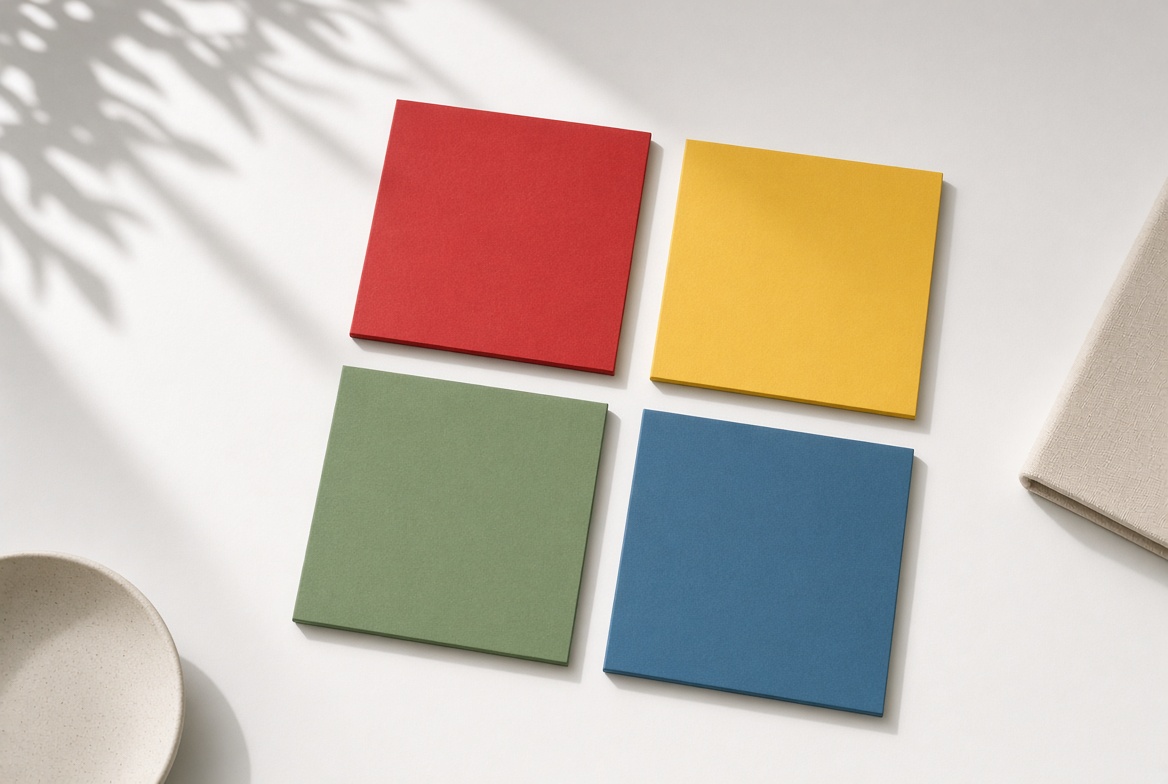
Color personality systems put four styles on a simple palette. They are easy to teach in a workshop. They are not one scientific model. At least three commercial families use colors and disagree about what each color means. This site’s quiz is original. It is not True Colors, not Taylor Hartman’s Color Code, not Insights Discovery, and not official FPA. Take the four-color test, then read the labels as they are used here.
Several color systems, not one
True Colors (Don Lowry, 1978) grew out of Keirsey temperament ideas and was first used with at-risk youth. Its four colors are Blue (people and relationships), Gold (responsibility and planning), Green (independent analysis), and Orange (action and freedom). Wikipedia’s article on True Colors notes that people are described as a mix, with two leading colors.
The Color Code / Hartman Personality Profile (Taylor Hartman) uses motive, not temperament: Red motivated by power, Blue by intimacy, White by peace, Yellow by fun. Hartman has published informal population splits (for example Red ~25%, Blue ~35%, White ~20%, Yellow ~20%). Those figures are not established in peer-reviewed population studies.
Insights Discovery uses Jungian language and four colors of its own (cool blue, earth green, sunshine yellow, fiery red). It is a facilitator-led commercial product.
Because the palettes disagree, “I’m a Red” is meaningless until you say which system. On this site the four labels are:
- Yellow — drive and the close (nearest to DISC D / Hartman Red / True Colors Gold-Orange mix depending on the item)
- Red — expressive energy and opening a room (nearest to DISC I / Hartman Yellow / True Colors Orange-Blue mix)
- Blue — analysis and a definition of done (nearest to DISC C / True Colors Green)
- Green — stability and a week that holds (nearest to DISC S / Hartman White / True Colors Gold-Blue mix)
If a book you own swaps Red and Yellow, ignore the crayon and read the description.
The four styles as this quiz uses them
Yellow. Moves toward a visible outcome. Useful when talk has replaced a decision. Cost: taking work back at night and training the room to wait. Write the decision rule before the meeting. Thank bad news early.
Red. Moves toward people and possibility. Useful when a room is dead. Cost: almost-yeses. Cap live projects. Put the ask in sentence one. Confirm yeses the next morning.
Blue. Moves toward accuracy after kickoff. Useful when being wrong is expensive. Cost: missing the window. Publish “enough,” then ship. Translate quality into a risk other styles can feel.
Green. Moves toward a stable week. Useful when the place has to keep standing. Cost: a silent yes. Ask for notice. Disagree in the meeting once, in one sentence.
Evidence
Hartman’s profile has face validity — people recognize the sketches — and no strong independent psychometric literature. True Colors publishes vendor reports; it is not a Big Five instrument. Four-color tools are closest in structure to DISC: two axes, four quadrants, workplace training. For trait scores use the Big Five. For four-letter type language use the 16 types test.